
Travel Planning5 min
Building Buffer Time Into a Long Trip
Where slack actually protects you, and where it just wastes a day.
Read GuideOne page, five lines, and far less stress when something goes wrong.
Rules change without notice. Confirm anything time-critical with the airline, airport or border authority handling your journey before you travel. Read our fact checking policy.
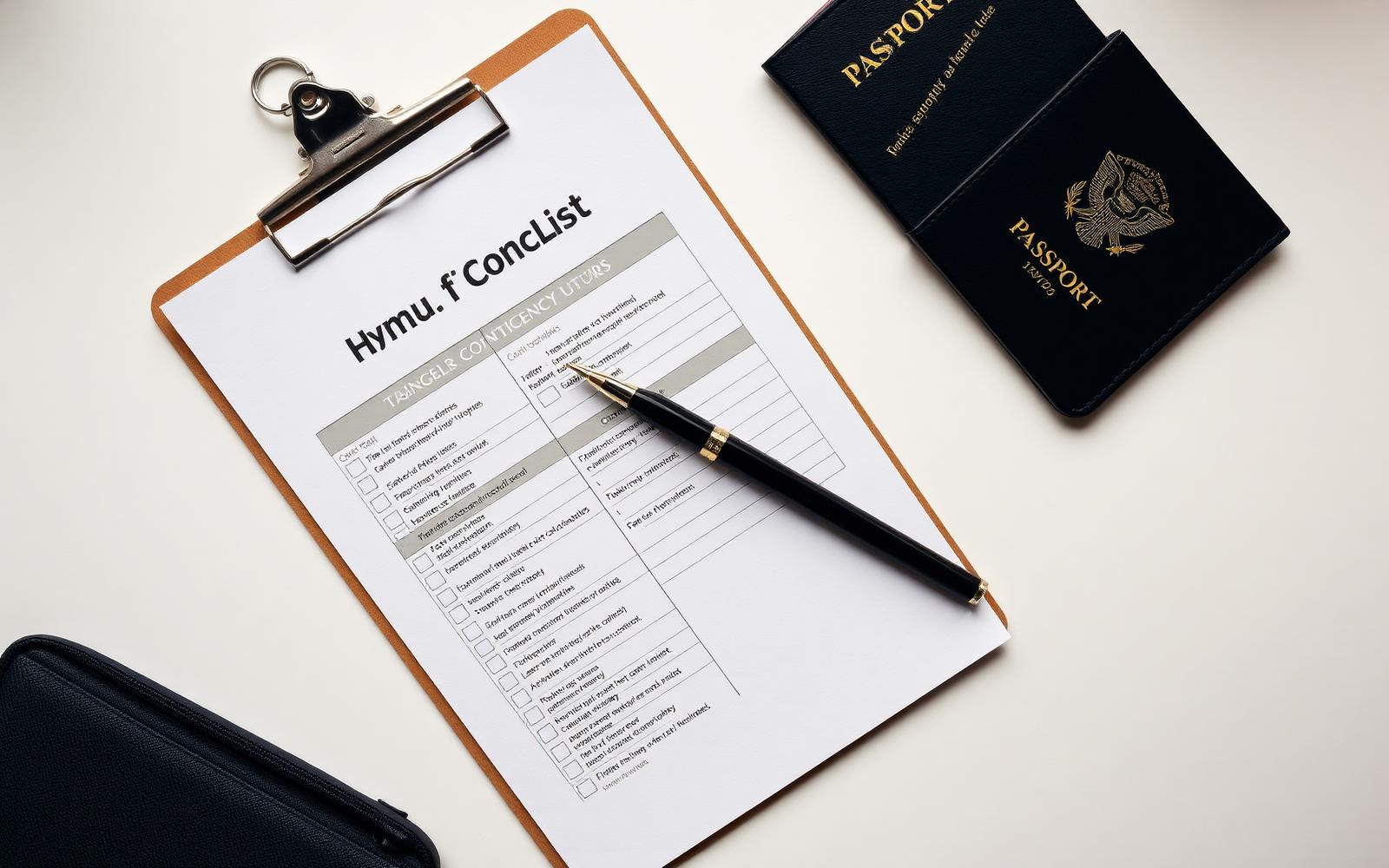
Write down your alternative flight, alternative airport, key phone numbers, and the last acceptable arrival time.
Identify one backup flight per critical leg in advance.
Save airline and insurer numbers offline.
Share the plan with someone not travelling with you.
Most travel problems are not solved by knowing more. They are solved by having decided in advance what you will do, so that you are not researching options at eleven at night in an unfamiliar terminal.
A backup plan does not need to be elaborate. Ten minutes before the trip, written into a note on your phone, is enough to cover the four things that actually go wrong.
This guide gives a template you can copy, and explains what to put in each line so it works when you are tired and the wifi is bad.
Almost every trip disruption falls into one of four categories, and each has a different answer.
| Failure | What it costs you | What the plan needs |
|---|---|---|
| Outbound flight delayed or cancelled | The whole trip start | Two alternative departures |
| Connection missed | Half a day or a night | The next two onward flights and the transfer desk location |
| Bag does not arrive | Clothes, medication, comfort | Essentials in cabin bag, claim process |
| Ground transport fails | The flight itself | A second route to the airport |
Ground transport is underrated
More flights are missed because of a cancelled train or closed motorway than because of anything the airline did. The second route to the airport is the most valuable line in the plan.
Copy this into a note on your phone and fill it in the day before departure. Keep it short enough to read on a locked screen widget.
Offline first
Save it as a plain note, not a document in cloud storage, and screenshot the key page. Airport wifi during a disruption is often unusable.

The point of naming alternatives in advance is that during a disruption you can request a specific flight rather than waiting to be offered one. Agents move much faster when you give them a flight number.
Naming the flight in Madrid
During a disruption at Madrid Barajas, a traveler asked the desk directly for the 19:45 Iberia service to Lisbon rather than asking what was available. The agent confirmed it in under two minutes, while the passengers ahead were still discussing options in general terms.
A surprising amount of disruption stress is caused by not being able to find a document. Build a small offline folder before you leave.
Do not rely on the airline app alone
Apps log out, tokens expire and phones lose signal. A downloaded PDF and one printed page cover almost every scenario where the app fails.
The best backup plan is a schedule that does not need one. Two structural decisions remove most of the risk before it appears.
First, avoid the last flight of the day for anything that matters, because there is no recovery option after it. Second, avoid arriving on the same day as an unmissable event.
| Situation | Recommended buffer |
|---|---|
| Connecting at a large hub | Minimum connecting time plus 30 to 60 minutes |
| Cruise departure | Arrive the day before |
| Wedding or conference | Arrive the day before |
| Separate tickets on one day | At least 4 hours, ideally overnight |
| Winter travel in northern Europe | Add an hour to every connection |
Share it
If two of you are travelling, both should hold the plan. Phones run out of battery at exactly the wrong moment.
Plan for four failures: the outbound flight, the connection, the bag, and the journey to the airport.
Write a short offline note with booking references, phone numbers, two named alternative flights, a second airport route, and your insurance details.
Naming a specific flight number during a disruption gets a faster answer than asking what is available.
The strongest backup is structural: avoid the last flight of the day, and never arrive on the same day as something unmissable.
Related
Guides that answer the questions readers usually have immediately after this one.
Where slack actually protects you, and where it just wastes a day.
Read Guide
The sequencing decision that quietly determines how flexible your trip is.
Read Guide
Three actions in the air and on the ground that keep your itinerary alive.
Read GuideNext steps
Refund Help
Travel Change Desk
Airline Rules Desk
Updated 20 July 2026
Updated 14 July 2026
Updated 9 July 2026
Updated 2 July 2026
Newsletter
A short email when a rule changes, a new guide lands, or a document requirement shifts. No promotions, no fares, no noise.
Open the Helpdesk. Eight desks, one structure, and an answer to the question you actually have.