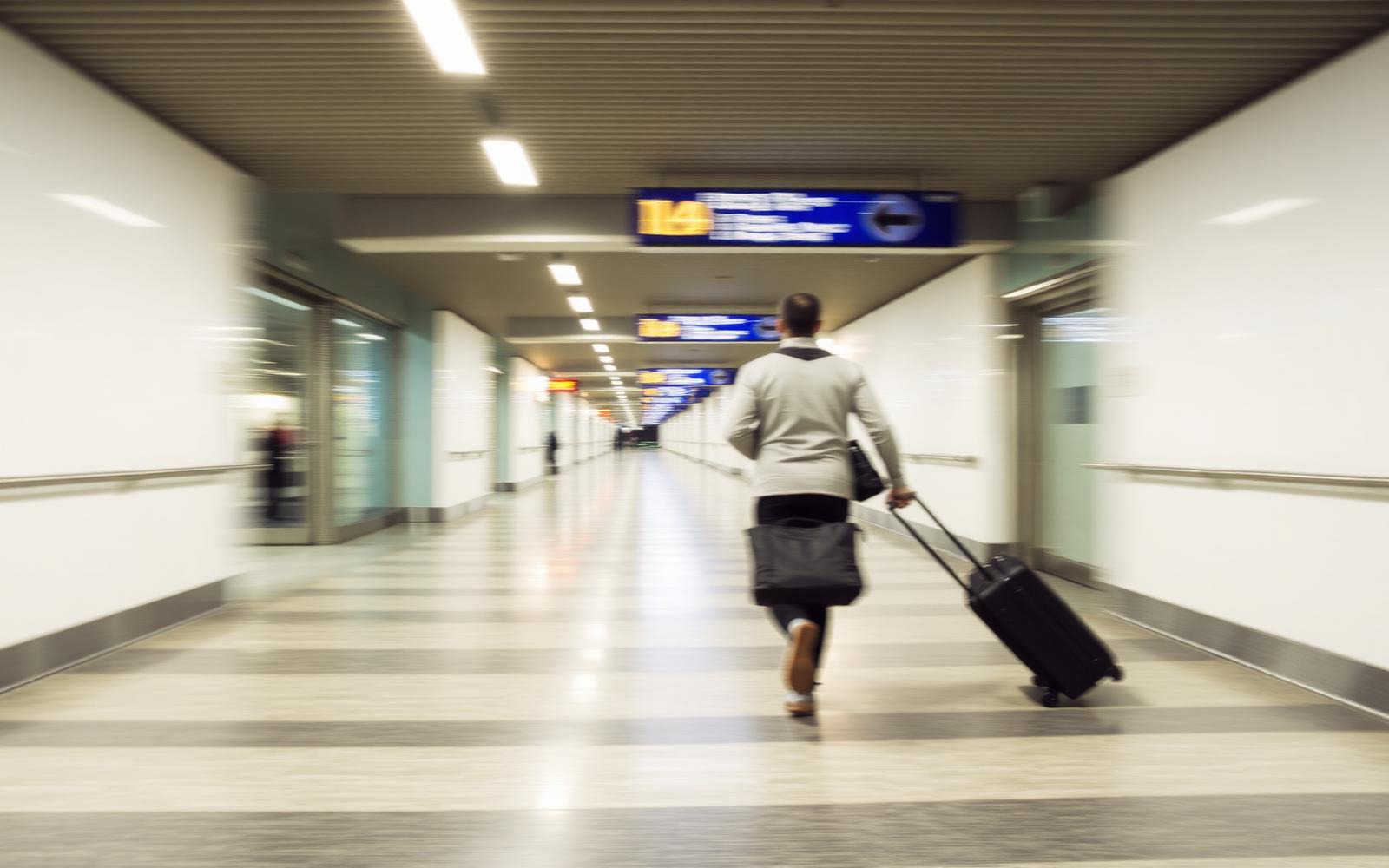
How Much Connection Time Is Genuinely Safe?
Minimum connection times are a legal floor, not a recommendation. Here is how to build a realistic buffer.
Read GuideThree actions in the air and on the ground that keep your itinerary alive.

Rules change without notice. Confirm anything time-critical with the airline, airport or border authority handling your journey before you travel. Read our fact checking policy.
On a single ticket, ask crew to flag your connection; on separate tickets, contact the second airline yourself.
Ask cabin crew to notify the ground team about tight connections.
Pre-select a backup flight so you can request it by number.
Move to the front of the cabin if crew allow it on arrival.
Your first flight is late and the connection is tight. There is usually a window of about forty minutes, while you are still in the air or still at the first gate, when the outcome can be changed. After that you are queueing with everyone else.
What you can do depends heavily on one thing: whether the whole journey is on a single ticket, or two separate bookings that happen to be on the same day.
This guide covers what to do while the first flight is still running late, how airlines decide who gets protected, and what changes when the tickets are separate.
On a single ticket, the airline owns the whole journey. If you miss the connection because the first leg was late, they must rebook you to your final destination at no cost, and provide care if the wait is long.
On separate tickets, each booking is a standalone contract. The second airline has no obligation at all, and a missed connection is treated as a no-show.
| Single ticket | Separate tickets | |
|---|---|---|
| Rebooking if you miss it | Free, airline's duty | At your own cost |
| Baggage transferred | Usually yes | No, collect and recheck |
| Care during the wait | Yes | No |
| Compensation possible | Yes, based on final arrival | Only for the delayed leg itself |
Check the ticket numbers
One ticket number covering all segments means one contract. Two separate thirteen digit numbers mean two contracts, whatever the booking site called it.
The most useful forty minutes of a tight connection happen before the aircraft door opens. Cabin wifi, even the slow free messaging tier, is usually enough.
Automatic protection happens quietly
Many carriers rebook at-risk passengers automatically while the inbound is still airborne. Check the app before you queue, because the new boarding pass may already be there.

If the connection is still technically possible, go for it, but decide quickly and take the fastest route. At large hubs the difference between the signposted route and the fastest route can be ten minutes.
Frankfurt, twenty-eight minutes
A Lufthansa passenger landed at Frankfurt with 28 minutes to a Concourse Z departure. The arrival gate agent directed her to a transfer lift most passengers walk past, saving roughly eight minutes on the standard route. She boarded with four minutes to spare, though her bag arrived the next day.
That last detail matters. Making the connection yourself does not guarantee the bag makes it, and on a single ticket the airline will deliver it to your address once it catches up.
Every airport publishes a minimum connecting time for each combination of terminals and flight types. If your itinerary meets it, the booking system considers the connection valid, even when it is uncomfortably tight in practice.
| Hub | Domestic to international | International to international |
|---|---|---|
| London Heathrow | 60 minutes | 75 to 90 minutes |
| Frankfurt | 45 minutes | 45 to 60 minutes |
| Amsterdam Schiphol | 40 minutes | 50 minutes |
| Paris Charles de Gaulle | 60 minutes | 60 to 90 minutes |
| Dubai | 75 minutes | 75 minutes |
| Atlanta | 40 minutes | 60 minutes |
Legal is not the same as comfortable
Minimum connecting times assume an on-time arrival, no gate change and no passport queue. On a booking you actually care about, add at least 30 minutes on top.
You are on your own contractually, but you are not out of options. The second airline will usually sell you a seat on a later flight, and some have an informal same-day policy that is cheaper than a new ticket.
Call before departure
A no-show is far more expensive than a change. Even five minutes before the scheduled departure, a phone call can keep the ticket alive.
Whether you are protected depends almost entirely on single ticket versus separate tickets. Check the ticket numbers before you travel, not during the disruption.
The useful window is while you are still in the air. Check the onward flight, look for an automatic rebooking, and hold a backup seat in the app.
On the ground, decide fast: either take the fastest route to the gate, or stop and rebook. Do not do half of each.
On separate tickets, call the second airline before the scheduled departure. A change costs money; a no-show costs the whole ticket.
This guide was written and checked against the following categories of primary source.
Air passenger rights regulators
Delay, cancellation and denied-boarding thresholds and duty of care obligations.
Official airline disruption policies
Carrier commitments on rebooking, meals and overnight accommodation.
Airport authority guidance
Operational status, disruption handling and passenger facilities during irregular operations.
Related
Guides that answer the questions readers usually have immediately after this one.
Minimum connection times are a legal floor, not a recommendation. Here is how to build a realistic buffer.
Read Guide
The label on the board changes your options, your entitlements and your next move.
Read Guide
The one connection step that catches out even experienced travelers.
Read GuideNext steps
Airline Rules Desk
Airport Guides
Refund Help
Updated 20 July 2026
Updated 9 July 2026
Updated 2 July 2026
Updated 25 June 2026
Newsletter
A short email when a rule changes, a new guide lands, or a document requirement shifts. No promotions, no fares, no noise.
Open the Helpdesk. Eight desks, one structure, and an answer to the question you actually have.