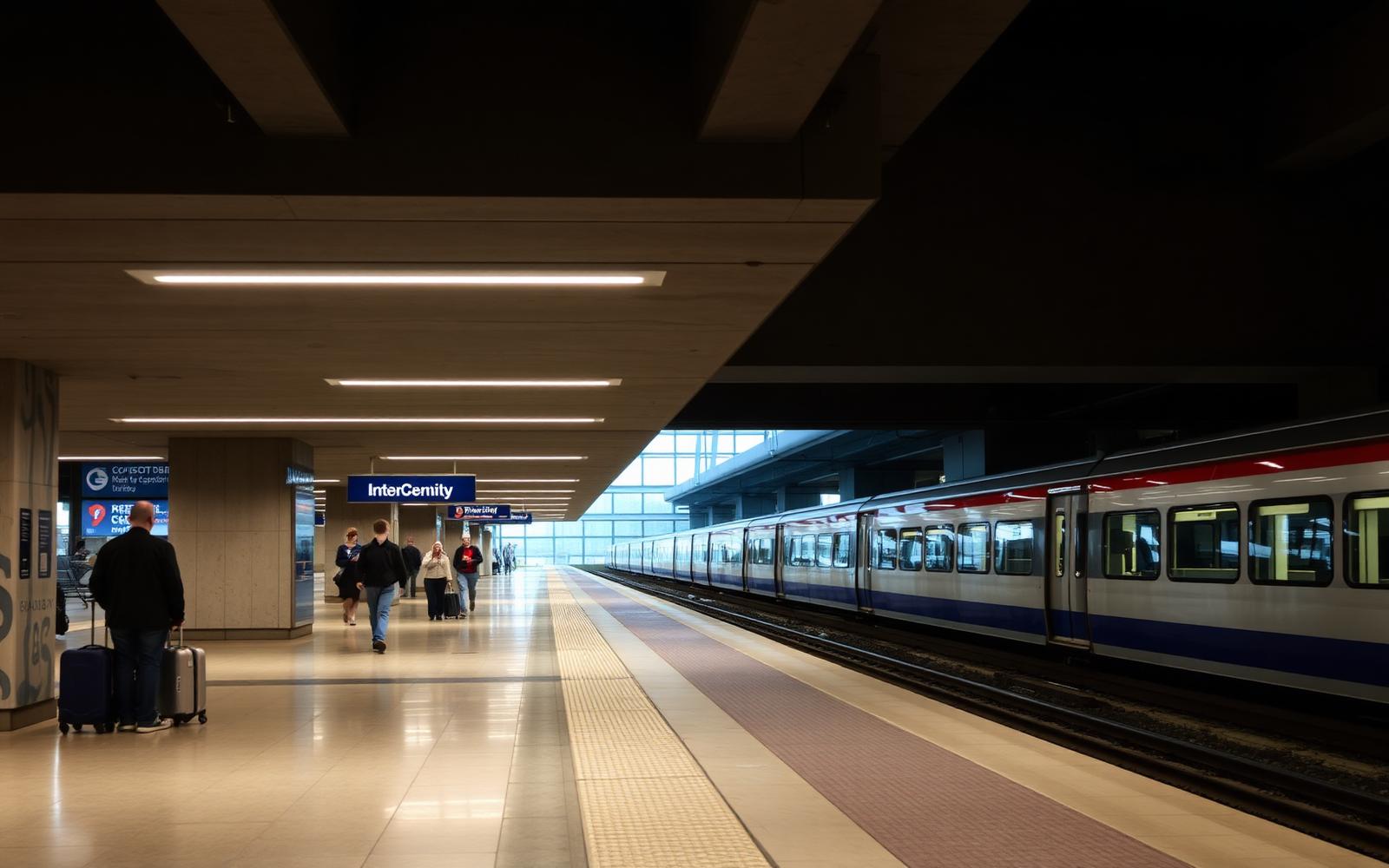
Combining Rail and Air on One Journey
Rail can replace a weak short-haul leg and remove an entire failure point from your trip.
Read GuideThe fare looks better. Then ground transport, timing and risk enter the calculation.
Rules change without notice. Confirm anything time-critical with the airline, airport or border authority handling your journey before you travel. Read our fact checking policy.
It is worth it when total door-to-door cost and time improve, not when only the airfare improves.
Add ground transfer cost and duration to both options before comparing.
Check the last departure of the day for the connecting transport.
Confirm luggage-friendly transport exists at arrival time.
Search for a flight to London and the results will offer you Heathrow, Gatwick, Stansted, Luton and London City, all under the same city name. One of them will be noticeably cheaper. Whether that saving survives contact with reality depends on things the search results never show you: the price of the coach, how long it runs, and what happens to your evening if the flight lands at 23:40.
This guide is about comparing airports properly, on total door-to-door cost and total door-to-door time, rather than on the headline fare alone. It is not an argument against secondary airports. Bergamo, Beauvais and Baltimore all make sense for the right traveler on the right day. The point is to know which day that is before you pay.
Everything below applies to the arrival airport and the departure airport equally. Travelers usually scrutinise the destination and skip the same analysis at their home end, which is where a lot of the hidden cost actually sits.
A fare is one line in a much longer bill. The honest comparison adds every cost you would not otherwise pay, on both ends of the trip, and every hour you would not otherwise spend travelling.
Milan, two ways
A flight into Milan Bergamo at 78 euros looks better than Milan Malpensa at 121 euros. Bergamo adds a 10 euro coach to Milano Centrale that takes an hour, plus the same on the return. Malpensa adds a 13 euro Malpensa Express train that takes 50 minutes. After transport, the gap is 98 versus 147 euros. Bergamo still wins, but by less than the search page suggested, and only if the coach is running when you land.
Count the hours as well as the euros
If a secondary airport saves 40 euros and costs three extra hours across the round trip, decide whether those hours were worth roughly 13 euros each to you. On a two week holiday that is easy to accept. On a two night work trip it usually is not.
Travelers assume the deciding factor is kilometres from the city. It is not. What matters is whether the link into town is frequent, direct and reliable at the hour you arrive.
London Stansted sits 68 kilometres from central London and still functions well, because the Stansted Express runs every 15 minutes into Liverpool Street and the coach network runs through the night. Paris Beauvais sits 85 kilometres out and behaves very differently, because the shuttle to Porte Maillot is timed to flights, sells out, and takes about 75 minutes in good traffic.
| Airport | Distance to centre | Main link | Practical feel |
|---|---|---|---|
| London Stansted | 68 km | Express train every 15 min | Genuinely workable at most hours |
| Paris Beauvais | 85 km | Flight-timed coach only | Workable, but no margin for error |
| Milan Bergamo | 50 km | Frequent coaches to Centrale | Reliable until late evening |
| Frankfurt Hahn | 120 km | Sparse coach to Frankfurt Hbf | Only for daytime arrivals |
| Baltimore BWI for Washington | 50 km | MARC and Amtrak to Union Station | Strong on weekdays, thin on Sundays |
| Oakland OAK for San Francisco | 30 km | BART via Coliseum | Good, until BART stops around midnight |

This is the single check most people skip. Cheap flights cluster at awkward hours, and awkward hours are exactly when ground transport thins out or stops.
If your flight into Girona is scheduled at 22:55 and the last Sagalés coach to Barcelona leaves at 00:15, a 90 minute delay does not cost you 90 minutes. It costs you a taxi of well over 100 euros, or a hotel night in Girona and a morning train. The fare saving disappears in one line.
Departure timing has the same trap in reverse
A 06:30 departure from a secondary airport often means no public transport exists early enough to reach it. You end up paying for a night in an airport hotel, which is rarely cheaper than the primary airport fare you rejected.
Ground transport looks equivalent on paper and is not equivalent in practice. A coach with a hold takes two large suitcases without drama. A regional train with narrow doors and no luggage racks does not, especially at rush hour.
Where the maths flips
For one traveler with a backpack, Frankfurt Hahn to Frankfurt Hauptbahnhof costs about 18 euros on the coach. For a family of four with three checked bags, that is 72 euros each way plus a fight for luggage space, and the primary Frankfurt airport, which has a station directly under the terminal, becomes the cheaper option overall.

Primary airports have more flights on the same routes, which means more recovery options. If a British Airways service from Heathrow to Madrid cancels, there are several more that day plus partner airlines. If a single daily low-cost rotation from a regional field cancels, the next one may be tomorrow.
Frequency is a form of insurance, and it is worth pricing. A route with six daily departures gives you a realistic same-day recovery. A route with one gives you a hotel.
Check both airports on the return, not just the outbound
Plenty of itineraries work best mixed: fly into the secondary airport in the morning when transport is plentiful, and fly out of the primary airport in the evening when you have a meeting or a train to catch. Search engines rarely suggest this, but nothing stops you booking two one-way tickets to do it.
One saving that is usually real
Secondary airports are typically smaller, so security queues are shorter and the walk from kerb to gate is often under ten minutes. If you value a calm departure over a large lounge, that is a genuine benefit and not just a consolation.
You do not need a spreadsheet. You need five minutes and four numbers for each option.
If the secondary airport wins on the first two and loses by less than an hour on the third, take it. If it only wins on the fare, and the fourth number is a hotel night, the primary airport was cheaper all along.

The cheaper fare is only the first number in the comparison. Ground transport in both directions, luggage fees and the value of your own time regularly close the gap, and sometimes reverse it entirely.
Distance from the city matters far less than the quality and frequency of the link. Sixty kilometres with a train every fifteen minutes is easier than thirty with a coach timed loosely to flights.
Check the last departure of your intended transport against a delayed arrival, not the scheduled one. That single check catches most of the expensive surprises that secondary airports produce.
Route frequency is insurance. When a route runs once a day, a cancellation costs you a night. When it runs six times, it costs you an afternoon.
Related
Guides that answer the questions readers usually have immediately after this one.
Rail can replace a weak short-haul leg and remove an entire failure point from your trip.
Read Guide
The uncomfortable answer, and the three moves that limit the damage.
Read Guide
Two separate tickets can cut the price of a long journey. They also move all connection risk onto you.
Read GuideNext steps
Travel Change Desk
Airline Rules Desk
Airport Guides
Updated 20 July 2026
Updated 14 July 2026
Updated 9 July 2026
Updated 27 May 2026
Newsletter
A short email when a rule changes, a new guide lands, or a document requirement shifts. No promotions, no fares, no noise.
Open the Helpdesk. Eight desks, one structure, and an answer to the question you actually have.